

How many subscriptions does your household currently have?
Most of us, when we consider subscriptions, think Netflix, Prime, perhaps an online newspaper or magazine. But if you pause for a moment, there are probably more than you realise, and they’re not cheap!
Subscription creep is a real thing. It’s that quietly increasing number of services we sign up to without even noticing.
Companies offering subscriptions know what they’re doing. They’ve done the research and have realised that they can attract customers with catch-phrases like, Free trial, Save time, along with psychologically small payments, i.e., $9.99 per month or ‘less than the price of your daily coffee’.
They rely on you being too busy to notice gradual price increases or remembering to cancel free trials before the paid service kicks in. And then there’s the option to pay more to go ad-free. What’s with that?!
They guess that you’re unlikely to track what other family members have signed up to and won’t advise you if you’re paying for duplicates of the same service.
Forgotten subscriptions reduce your disposable income and negatively skew your financial situation, sometimes by thousands of dollars each year. This can have a real impact on your lifestyle. For example, you could be:
- paying your mortgage down quicker,
- enjoying more relaxed financial circumstances,
- or, limiting your borrowing power if you’re applying for finance or renegotiating an existing loan.
If you’re wondering where your money is going, or how many services you’re forking out for, start with an audit of everything your household has signed up to.
This is how you do it:
- Gather everyone and list the services each person subscribes to.
- Check bank records, email accounts, digital wallets and credit cards for payments.
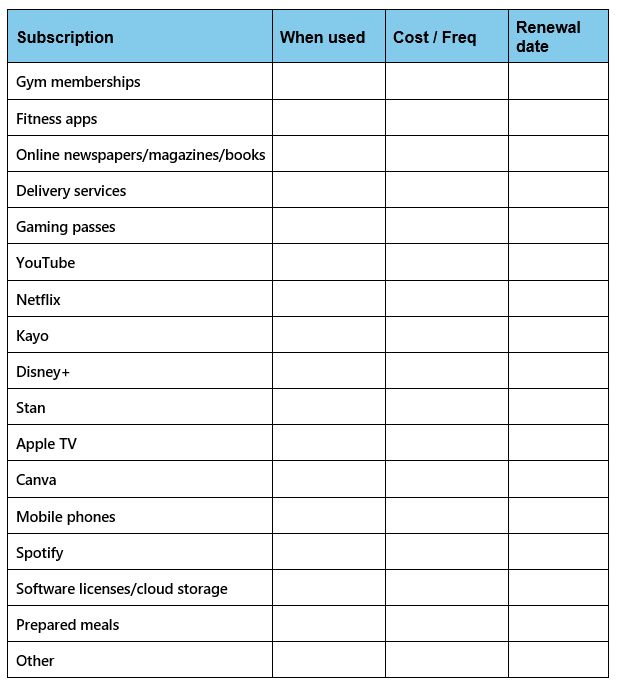
- Create a master list of:
- who has what
- how often it’s used
- cost and frequency
- renewal date.
- Identify duplicates and cancel them, and others you’re not using.
- Review free trials and cancel them if you’re not going ahead.
- Change automatic renewal options to manual renewal.
- Schedule an annual audit and repeat these steps.
Here’s a table with some common subscriptions to get you started. Add more if you need to.
Once you’ve offloaded unused subscriptions, you can redirect the savings to other purposes.Remember that if you don’t put savings to good use, you’re no better off, so ensure you do something worthwhile with the money.
A chat with your financial advisor or accountant will assist in creating, or revising, your budget and identifying the most effective use for cash you save.
Of course, not all subscriptions are unnecessary; some are helpful and convenient. Only you can decide which ones are, and are not, worth your money.
Identifying unnecessary subscriptions is a great first step, but having a plan for the savings is just as important.
If you’d like guidance on creating a budget, improving your cash flow or putting those extra dollars towards your financial goals, speak with one of our advisers today.
| The information provided in this article is general in nature only and does not constitute personal financial advice. |